

Skincare has evolved far beyond simple cleansing and moisturizing. Today, one of the most talked-about categories is acids—often praised for their ability to smooth, brighten, and renew the skin.
But here’s the truth:
Not all acids are created equal.
And more importantly—not all acids should be used together.
Understanding how these ingredients work allows you to care for your skin in a way that supports balance, not damage.
What Are “Acids” in Skincare?
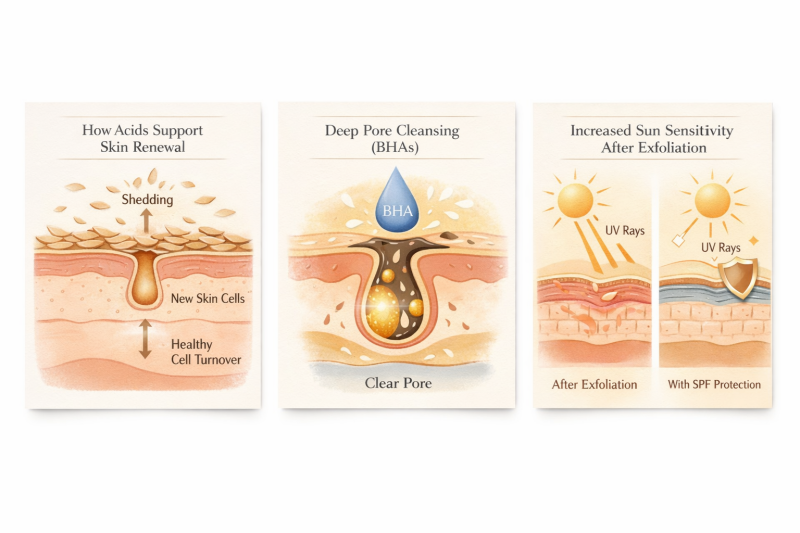
In skincare, “acids” are active ingredients designed to exfoliate, hydrate, or treat specific skin concerns. Most of them work by loosening the bonds between dead skin cells, allowing the skin to naturally shed and renew itself.
They fall into a few main categories:
• AHAs (Alpha Hydroxy Acids) – surface exfoliation
• BHAs (Beta Hydroxy Acids) – pore penetration
• PHAs (Polyhydroxy Acids) – gentle exfoliation + hydration
• Other treatment acids – like azelaic acid or hyaluronic acid
Each type interacts with the skin differently.
The Main Types of Skin Acids
1. AHAs (Alpha Hydroxy Acids)
Examples: Glycolic Acid, Lactic Acid, Mandelic Acid
What they do:
- Exfoliate the surface of the skin
- Improve texture and tone
- Brighten dull skin
- Support cell turnover
How they work:
AHAs are water-soluble, meaning they work on the top layer of the skin. They break down the bonds that hold dead skin cells together, allowing them to shed more easily.
Best for:
- Dry skin
- Dullness
- Uneven tone
2. BHAs (Beta Hydroxy Acids)
Example: Salicylic Acid
What they do:
- Penetrate pores
- Dissolve oil buildup
- Reduce breakouts
How they work:
BHAs are oil-soluble, allowing them to travel deeper into the pores and help clear congestion from within.
Best for:
- Oily skin
- Acne-prone skin
- Blackheads
3. PHAs (Polyhydroxy Acids)
Examples: Gluconolactone, Lactobionic Acid
What they do:
- Gently exfoliate
- Hydrate while exfoliating
- Support the skin barrier
How they work:
PHAs have larger molecules, so they penetrate more slowly, making them a gentler option for sensitive or compromised skin.
Best for:
- Sensitive skin
- Dry or reactive skin
- Beginners
4. Azelaic Acid
What it does:
- Brightens skin
- Reduces redness
- Helps with acne and pigmentation
How it works:
Azelaic acid works more as a treatment acid, helping regulate skin cell production and inflammation.
5. Hyaluronic Acid (Not an exfoliating acid)
What it does:
- Hydrates
- Attracts water to the skin
Important note:
Despite the name, this is not an exfoliating acid. It supports moisture and balance.
How Acids Affect the Skin
Acids accelerate skin turnover—which can be beneficial when used correctly.
But when overused or combined improperly, they can:
- Disrupt the skin barrier
- Cause irritation or redness
- Lead to dryness or sensitivity
- Increase sun sensitivity
This is where intention matters.

How Acids Affect the Skin
Acids support the skin’s natural renewal process by encouraging cell turnover.
When used correctly, they can:
- Smooth texture
- Brighten tone
- Support clearer skin
But when overused or combined improperly, they can:
- Disrupt the skin barrier
- Cause irritation or redness
- Lead to dryness and sensitivity
- Increase vulnerability to sun damage
This is why intention and balance matter.
Acids You Should Avoid Using Together
Layering multiple strong actives can overwhelm the skin and lead to irritation.
Avoid Combining:
- AHA + AHA (multiple strong exfoliants)
- AHA + BHA (unless guided carefully)
- AHA + Retinol
- BHA + Retinol
- Strong acids + Benzoyl Peroxide
- Acids + high-alcohol toners or peels
Use Caution With:
- Azelaic Acid + strong AHAs (may increase sensitivity)
- PHAs + other acids (gentle, but still active)
Key principle:
More is not better—balance is better.
Acids and Sunlight: What You Need to Know
Many acids increase photosensitivity, meaning your skin becomes more vulnerable to UV exposure.
Especially sensitive in sunlight:
• Glycolic Acid
• Lactic Acid
• Salicylic Acid
• Retinol (often used alongside acids)
Best Practices:
• Use exfoliating acids at night
• Apply SPF daily
• Avoid direct sun exposure after use
Protecting your skin is just as important as treating it.
When and How to Use Acids
Beginner Routine
• Start 1–2 times per week
• Use one acid at a time
• Apply at night on clean skin
• Follow with hydration
Moderate Routine
• Use acids 2–3 times per week
• Alternate actives on different days
• Focus on restoring moisture in between
Advanced Routine (with care)
• Rotate acids strategically
• Avoid stacking multiple exfoliants in one routine
• Pay close attention to how your skin responds
How to Pair Acids Safely
Instead of layering strong actives together, balance them with supportive ingredients:
• Hydrators (like hyaluronic acid)
• Barrier-supporting ingredients (plant oils, ceramides)
• Calming extracts (like green tea or panthenol)
This allows your skin to renew without becoming overwhelmed.
A Holistic Perspective on Skin Renewal
Your skin already knows how to renew itself.
Acids are not meant to force the process—they are meant to support it gently.
Over-exfoliation can:
- Disrupt your skin’s natural rhythm
- Trigger inflammation
- Lead to long-term sensitivity
Balanced skincare focuses on:
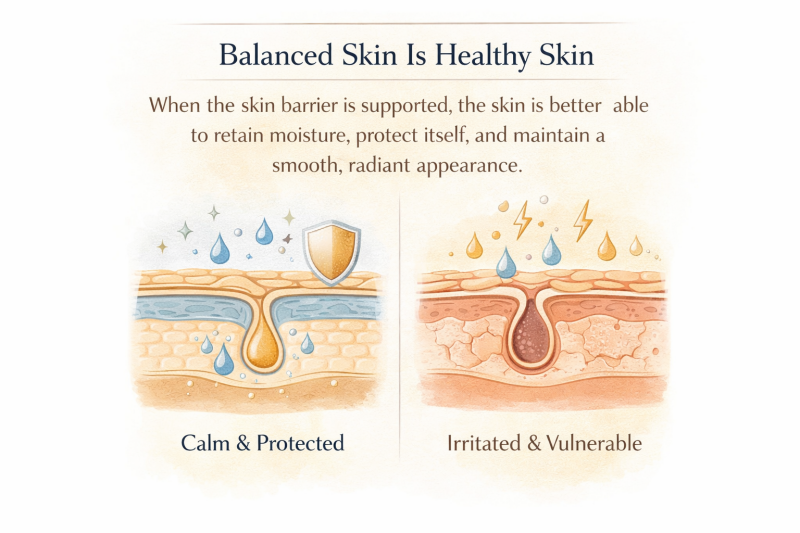
- Supporting the barrier
- Encouraging steady renewal
- Maintaining hydration
Supporting Your Skin’s Natural Rhythm
Not every skin needs strong acids.
Not every routine needs frequent exfoliation.
The goal is not to chase quick results—it is to build consistency and maintain balance.
If you choose to use acids:
- Start slowly
- Pay attention to your skin’s response
- Avoid unnecessary combinations
- Protect your skin from sun exposure
And most importantly—
work with your skin, not against it.
Sources & References
- American Academy of Dermatology (AAD) – https://www.aad.org/public/everyday-care/skin-care-basics/care/exfoliation
- U.S. Food and Drug Administration (FDA) – https://www.fda.gov/cosmetics/cosmetic-products/alpha-hydroxy-acids
- Cleveland Clinic – https://my.clevelandclinic.org/health/treatments/22164-chemical-exfoliation
- Harvard Health Publishing – https://www.health.harvard.edu/staying-healthy/do-you-really-need-to-exfoliate
- Van Scott EJ, Yu RJ. Control of keratinization with alpha hydroxy acids.
https://pubmed.ncbi.nlm.nih.gov/2948921/ - Green BA, Yu RJ, Van Scott EJ. Clinical and cosmetic benefits of polyhydroxy acids.
https://pubmed.ncbi.nlm.nih.gov/11055212/ - Fitton A, Goa KL. Azelaic acid: a review of its pharmacological properties.
https://pubmed.ncbi.nlm.nih.gov/7697588/ - Elias PM. Skin barrier function and its importance in dermatology.
https://pubmed.ncbi.nlm.nih.gov/?term=skin+barrier+function+elias
Add comment
Comments